Tribeca Festival 2026, Part 1
Tribeca Festival was the very first film festival I’ve ever attended. It was the summer of 2024 when I went and I got the chance to see so many wonderful (and not so wonderful) films. Although I couldn’t attend in 2025 due to interning abroad, I was excited to spend another week and a half in Lower Manhattan doing what I love: watching movies and briefly writing about them.
This article will cover the films I saw on June 4th, 5th, and 7th. I spent the late night of the 5th and all of the 6th on the Jersey shore celebrating my sister’s birthday weekend. Here are the films:
Imaginal Disk – June 4, 8:30pm, Spring Studios
The Accompanist – June 5, 5:15pm, Village East by Angelika
Bob and David Climb Machu Picchu – June 7, 5:45pm, Village East by Angelika
Turn It Up! – June 7, 9:15pm, AMC East 19th St.
[SPOILERS FOR ALL FILMS INVOLVED]
Imaginal Disk
⭐⭐⭐⭐⭐
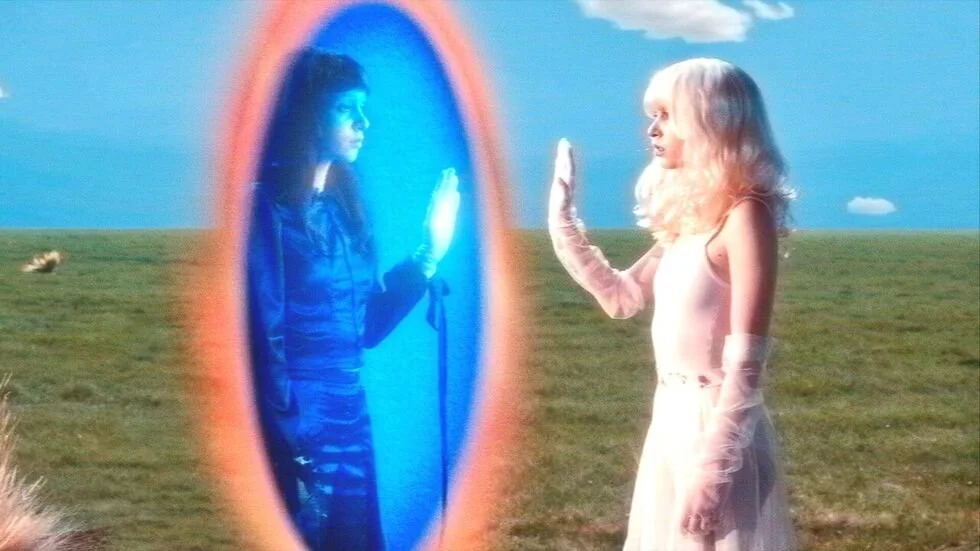
Two summers ago, Magdalena Bay — consisting of musicians Mica Tenenbaum and Matthew Lewin — rocked the world with their sophomore studio album Imaginal Disk. A loose concept album, it is one that transcends body and soul. It neatly combines existential lyricism that tackles identity and what it means to be human, and genre-blending synth melodies that grow more chaotic the further they go. Since its release in August 2024, Imaginal Disk has launched Magdalena Bay into the stratosphere, being hailed as one of that year’s best albums.
This feature-length companion visualizer is written, edited by, and starring Magdalena Bay. Furthermore, it is directed by Amanda Kramer, who has not only directed music videos for the band but also made splashes in the independent film community with 2022’s Please Baby Please and 2025’s By Design — both of which are absurdist and feminist works.As of now, Imaginal Disk has yet to be released.
Anyway, the film provides psychedelic imagery that communicates each song’s theme and sound. This was already explored in some promotional music videos (including “Image,” “Death & Romance,” “Tunnel Vision” and “That’s My Floor”), albeit they seem to be more like puzzle pieces in the grand scheme of the film. And in spite of how disjointed and experimental all the scenes appear, the core structure of the album is never lost. Fans of the album will instantly level on the same wavelength as the film, and casual moviegoers will be in for a wild hour.
Imaginal Disk follows True (Tenenbaum), a young woman stuck in mundanity until receiving the eponymous disk and embarking a transcendent odyssey of self-discovery once it is ejected. Also appearing throughout the film is a Ghost (also Tenenbaum) meant to represent the natural, tragic side of True and thereby the voice of the more melodramatic songs. Moreover, Tenenbaum’s vocal inflections are distinct between the two, True’s being bombastic with Ghost’s being much softer. Other characters include Lewin as a silent musician whose eye make-up is absurdly funny, a blank figure who the Ghost loved and lost, killer aliens, faceless morph-suited people, and a surgeon who would fit snugly in I Saw the TV Glow.
Again, the imagery naturally complements the main theme/tone of the album and each song. In “Killing Time,” a yacht-rock tune that describes and questions the mundanity of life, the film establishes True in a plain suburban home/backyard although the style seems…uncanny. “Image” experiments more with the idea of a sense of self through constant shapeshifting/customization of True. “Death & Romance,” the viral pop hit, explores the importance of love with the doomed melodramatic romance between the Ghost and the aforementioned blank figure; its outro “Fear, Sex” establishes the connection between True and Ghost through a portal that also serves as a metaphor for the natural versus the digital.
“Vampire in the Corner” perfectly communicates the idea of self-loathing and “loving so much it kills you” by having True perform onstage for the faceless people and getting maimed by a mantis-like figure in a seconds-long dream sequence. The last three sequences explore realization and reversion as True is reborn into an angelic-like being (“Angel on a Satellite”) who reverts back to her true self once the Imaginal Disk is reinserted, which feels like a final acceptance of herself. It’s played out like a hopeful ending as inferred by the final upbeat song “The Ballad of Matt & Mica.”
Both Kramer and Magdalena Bay understand how to properly execute the themes and tones of the songs through creative visual imagery. There are a plethora of interesting visual effects from 2D animation to claymation. The glitchy editing gives the film a late-nineties, early-aughts VHS feel. Some sequences manage to replicate the eerie dreaminess of David Lynch or Jack Stauber such as “True Blue Interlude,” which plays out like a vaporwave uncanny advertisement for the Imaginal Disk.
Amidst the overstimulating Y2K images and kaleidoscopic Imaginal Disk, both the album and film, begs a simple question: who are you meant to be? The film makes it look tougher to answer due to its abstract narrative and approach, but it’s something that you would need to look deep inside, with or without Imaginal Disk.
The Accompanist
⭐️⭐️⭐️⭐️
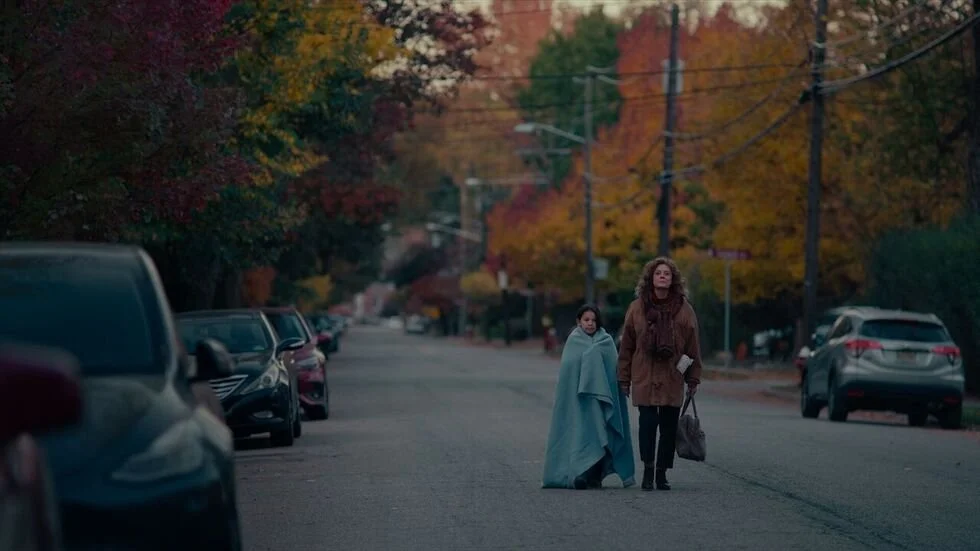
There are two given definitions of the word “accompaniment” according to the Merriam-Webster dictionary. The first, “an instrument or vocal part designed to support or complement a melody,” and the second, “an addition (such as an ornament) intended to give completeness or symmetry to something.” Strangely enough, both of these meanings apply to this deeply poignant but undeniably human film.
The Accompanist is the directorial debut of Zach Woods, known for his roles in numerous sitcoms from The Office to Silicon Valley, who co-wrote the script with Brandon Gardner. The film stars Susan Sarandon, Aubrey Plaza (also serving as the film’s producer), Kevyn Morrow, and introduces newcomer Everly Carganilla. It premiered on June 4 at the festival and is yet to be released.
From the moment it starts, the film just hooks you in. It opens on a young interpretive dancer in a lobby of some sort, who calmly dances before violently fisting herself in the stomach. It not only establishes the main themes of trauma, but it entices you into knowing who this dancer is and why this scene matters in the context of the film.
A quick cut introduces Emily (Carganilla) and her living situation with her dementia-stricken grandfather Martin (Morrow) in Bayonne, New Jersey. One of two things Woods absolutely nails as a filmmaker is visual storytelling. There are more than enough details and actions that infer the audience about a character without ever being explicit. Throughout the house, there are cluttered items and multiple signs written with simple actions like “Take out the trash” that infer Martin’s condition.
The other thing Woods accomplishes successfully is writing and directing a child character. Typically when doing this, it’s very important to understand how a kid speaks and behaves; otherwise, it would ruin how real they feel. Emily talks and acts very believably like a kid. After the accident – where Martin unknowingly drives on train tracks and nearly gets him and Emily struck by an oncoming train – Emily asks the school nurse if there is “medicine for confusion.” She knows something’s wrong with her grandfather but not in the way that the audience does, knowing it’s much more complicated. It’s intuitive but not all-knowing. This is also not to mention that Everly Carganilla gives a wonderful debut performance as the character. Even with cinematography does the film understand Emily; most shots from her perspective are framed on her level or lower.
The interaction with the school nurse has consequences later as the next day, a social worker, Sarah (Plaza), comes to their house and takes Emily away after Martin (understandably confused) causes an altercation. The scene is played out very traumatically because it is exactly that; who would want to be taken from the only family they have? But it’s also important to note that Sarah, whether or not she can be viewed as an antagonist, is not vilified but instead humanized. Her taking Emily is not necessarily out of anger but out of impulse and while it’s still a bad idea regardless, it was the heat of the moment. You can even hear the panic and unsureness in Plaza’s voice during the drive. Sarah later apologizes for this event upon visiting Emily again.
With all this, Emily is now left in the care of Sylvia (Sarandon), a 73-year-old foster parent. Although there is some initial friction, the two create a deep found-family bond. The chemistry between them is easily the highlight of the film as well as its driving emotional force. Both characters couldn’t be more different but the one thing they do share is guilt and trauma. Emily from being separated from her grandfather, and Sylvia from losing Nadia, her ballet-dancing dancer who died from anorexia. She’s the dancer from the beginning of the film and every sequence with her is a dream sequence.
The character of Sylvia is the most interesting in the film because she feels the most human. She’s old but experienced; this is shown not in her actions but also when seeing the inside of her house, filled with multiple Polish and Jewish artifacts as well as an old grand piano. She carries trauma but masks it with dark humor and quirky quips. Even in her rare moments of vulnerability – notably when she first mentions Nadia to Sylvia one night in a mall – Sylvia has trouble opening up and letting go of the past, which causes the second/third act conflict. This is also made interesting due to Susan Sarandon giving a powerhouse lead performance.
Towards the end of the film, after many tribulations, runaways, and highs and lows, Sylvia finally comes to terms with Nadia’s death. This is shown through one last dream sequence, in which Sylvia plays a gentle tune on the piano and Nadia’s violent stomach jabs revert to the graceful interpretive dance seen earlier. The film ends on Emily and Sylvia in a close embrace. It is a powerful scene where its actions speak louder than words, but it also brings together the double meaning of the word “accompaniment.” In spite of everything, through music and separate trauma, Sylvia and Emily brought each other together, both of them accompanists.
Bob and David Climb Machu Picchu
⭐️⭐️⭐️⭐️

Before diving into the main subject at hand, it's important to bring up an early-mid 90s sketch-comedy show: The Ben Stiller Show. In spite of its short-lived 12-episode run, the series brought numerous people in the comedy scene into the limelight from its star Ben Stiller to its producer Judd Apatow. But amongst them brought together a certain duo: Bob Odenkirk and David Cross. After some comedy club routines and appearances on other sitcoms (i.e. The Larry Sanders Show), Bob and David created and starred in their own sketch show: Mr. Show with Bob & David. Aired on HBO and spanning 4 seasons, Mr. Show is widely considered a cult classic in the comedy television sphere, known for its offbeat absurd humor that inspired everything from Tim & Eric Awesome Show, Great Job! to Portlandia.
After the series ended in 1998, the two’s careers took interesting trajectories. David continued comedy in mainstream films and TV shows, notably Arrested Development and the Kung Fu Panda movies. Meanwhile, Bob struck gold with a more dramatic turn as a scummy lawyer going by the name of Saul Goodman in the iconic series Breaking Bad and Better Call Saul. The two, still great friends, have collaborated again as seen in the Mr. Show spin-off film Run Ronnie Run, the Netflix miniseries W/ Bob & David, and this documentary.
Bob & David Climb Machu Picchu is directed by Michael LaHaie, starring and produced by the titular duo. The plot is as the title implies: Bob Odenkirk and David Cross spend 4 days (or just about 80 minutes per the film) hiking one of the Seven Wonders of the World. Below the surface however, the documentary further explores the decades-long friendship between the two as well as themes of reflection and existentialism.
David had organized the trip as something he had wanted to do before growing old. And who else to join him on the trek but Bob, who had (then) recently recovered from a severe heart attack in 2021. Once packed and arrived in Cusco, Peru, the two start their journey across the daunting high-altitude mountains with their guide Jose and the camera crew. Apart from footage of the climb, there is also archive footage of Bob and David as up-and-coming comedians and behind the making of Mr. Show.
The main thing the documentary captures is, of course, Bob and David and their friendship. After what seems like years from their previous on-screen appearance, their rapport is still incredibly strong and incredibly funny. Throughout the trip, the two naturally make very witty and absurd jokes. This is either done while on the hike or through voiceover narration when the small microphones attached keep cutting the dialogue (briefly for one sequence). Sometimes, Jose would go along with their bits which makes those moments even funnier and brings me to the documentary’s next achievement. Apart from its core story, the documentation of Peru and Peruvian culture is also impressive. It’s not done to laugh at the people but to laugh with them. From watching a festival in Cusco to buying a hat and cacao leaves from an elderly vendor to holding a meet-and-greet with varying success, Bob and David interact with the polite community of Peruvians in a way that’s equally polite as well as entertaining.
Despite all the bits and comedy, the documentary additionally tackles some personal issues. In one moment of downtime, Bob and David talk about their fathers and how their issues with them shaped them as comedians and people. This moment doesn’t feel very forced and flows naturally as a part of the theme of self-reflection. Moreover, towards the last leg of the trip when the duo arrive at Phuyupatamarca, they read letters from their families about the journey in both the physical and emotional senses. The emotion throughout the scenes are carried by the score by indie band Yo La Tengo.
You would think that when Bob and David finally arrive at Machu Picchu, the film would end on that catharsis. Actually, it’s even better. After a montage of pictures taken during the hike, there is a scripted sketch about two travel agents who specialize in “stay-vacations” and book stay-at-home trips for customers. It’s funny and feels right at home with Bob and David’s humor, but it goes to show that even after decades of friendship and an exhausting four-day hike, they’ve still got it.
Turn It Up!
⭐️⭐️
It’s best to be totally blunt and brief with this because there isn’t too much to talk about with this film and it was difficult to fully engage with it. And for a movie that’s mimicking the late-night campy horror genre, it fails to deliver exactly that. Turn It Up! is the directorial debut of Canadian filmmaker Sam Scott. Up to this point, he has directed some short films with some cast members from those returning here. It premiered as part of the festival’s Escape From Tribeca program for midnight movies.
The film follows AC (Justine Nelson), a bassist not only struggling with tinnitus, but also from a lowly unpopular band. Her bandmates — guitarist Court (Gwenlyn Cumyn) who’s thinking about leaving the band for a more responsible life, another guitarist Berg (Jonathan Craig) who’s a sarcastic hothead, and drummer Russ (Xavier Lopez) who's just kind of there. At an abandoned venue the band visits — later revealed to be a secret evil lab — AC encounters a spirit that brings her to another dimension through a certain vibration and gives her a cursed melody for the whole band to play. When the band gains traction, so does the curse that starts killing people by exploding their heads. While it draws the attention of a mad scientist posing as a manager (Liv Collins) and her father responsible for finding the sound and the dimension (Julian Richings), it also involves two special agents (Kris Siddiqi and Ry Barrett) familiar with otherworldly cases.
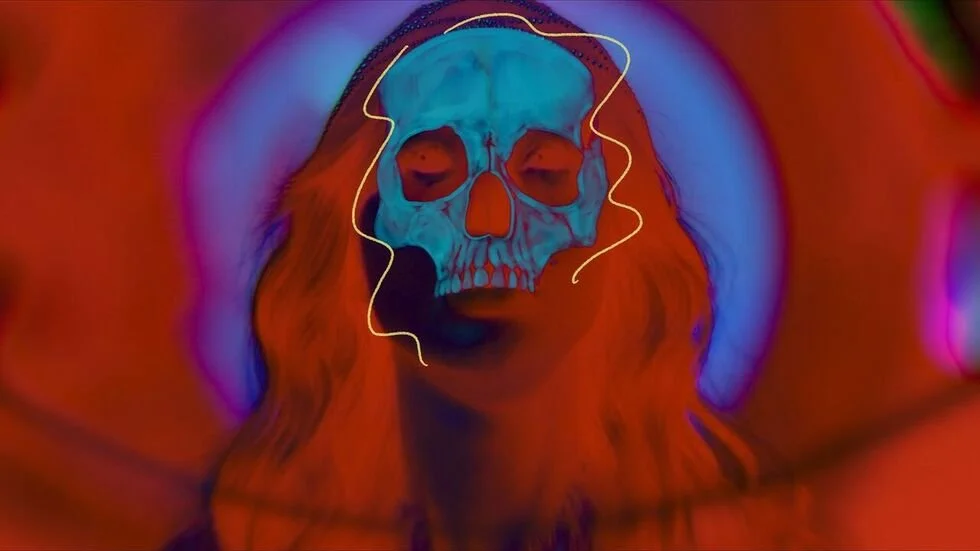
Turn It Up!’s biggest draw is its art direction, combining its live-action footage with hand-animated graphics. However, it’s also very inconsistent. The said graphics of skulls and brains everywhere only remain in the first act and feels more like a gimmick than an integral part of the story’s world. Nevertheless, some bits of VFX, notably the gore of exploding heads and black goo oozing from speakers, is cool to observe.
Another giant inconsistency is its tone. The film seems to want to be mainly a horror but its attempts at scares are bogged down by a ridiculous theremin score. Or it wants to be a campy comedy but its quips (mostly from Berg and Russ) are on the level of “Well, that just happened!” and ruins the tone of any dramatic scene. It isn’t helped by the acting that is not convincing enough to bring out the intended tone of a sequence, although the only exception to this is the two agents who share a fun rapport with each other and with their boss (Bruce McCulloch).
Another problem is how much it brings up topics only to barely scratch the surface. The curse — the black goo permeating in the brain due to the cursed melody — is also shown to bring out insecurity. We briefly see this with AC wanting to confess her love to Court and being rejected, and Berg wanting to make it big. These really are the only times it’s brought up; the story and its emotional core would benefit from expanding on this part of the curse.
In short, Turn It Up! is not funny enough to be campy, not chilling enough to be scary, and too much of a snooze to be a midnight movie. It’s noise with very little meaning.
