Hope
★★★
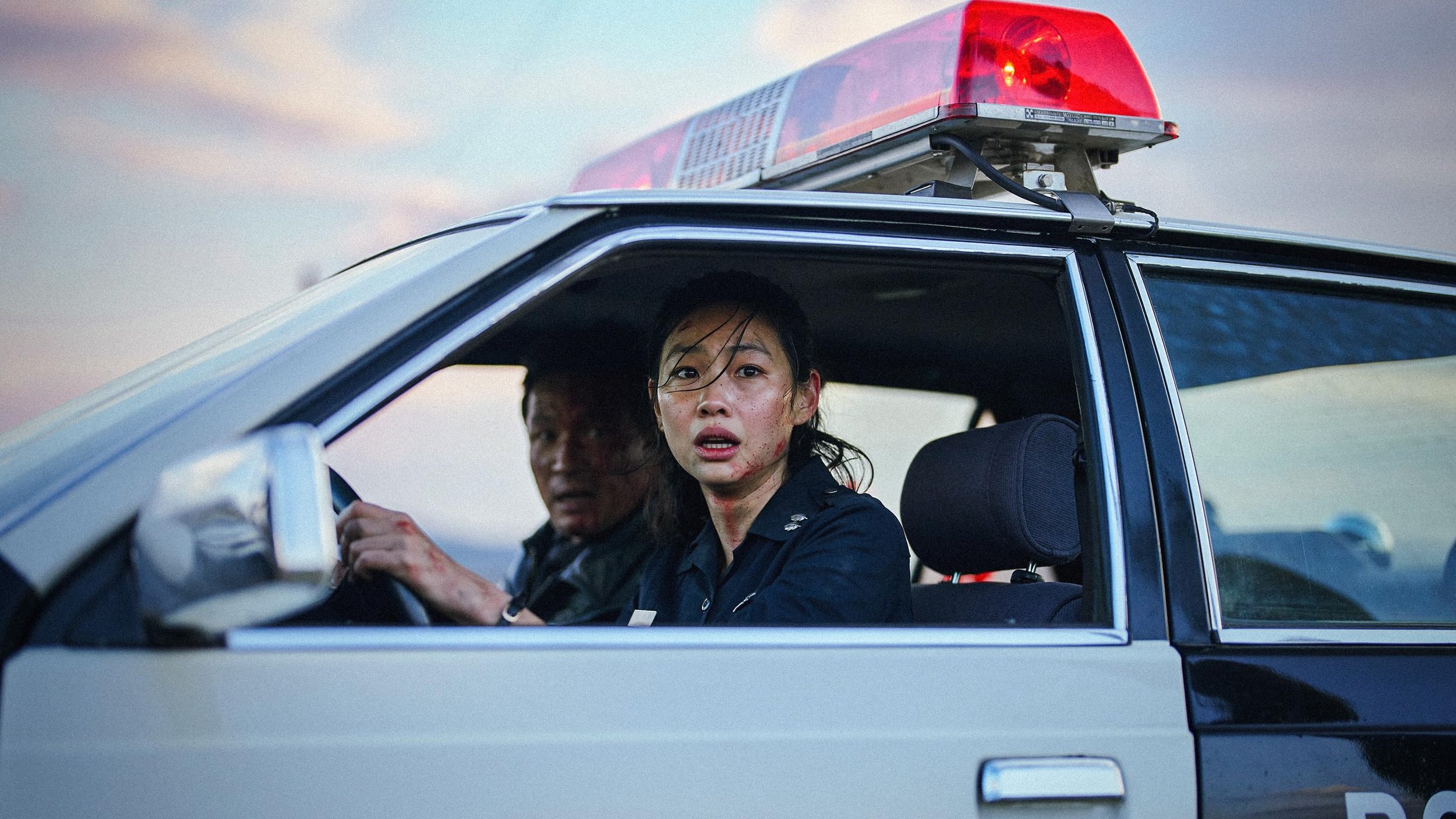
It’s no surprise that for the past twenty-five years, South Korean cinema has exploded into international fame. From Park Chan-wook’s magnificently fucked up Oldboy to Bong Joon-ho’s history-making Oscar-winning Parasite, Korean films are known for (masterfully or otherwise) combining several genres and their tropes to create a sharp, emotional commentary on the world. Both of these aspects are essential to understanding what kind of movie Hope is.
Hope is the fourth feature film from South Korean genre filmmaker Na Hong-jin, his first since The Wailing a decade ago. It stars an ensemble cast of Korean actors (Hwang Jung-min, Zo In-sung, and Hoyeon) and non-Korean actors (Alicia Vikander, Michael Fassbender and Taylor Russell). The film premiered at the Cannes Film Festival to relatively positive acclaim and will be released this Wednesday.
Set in the small coastal village of Hope Harbor in what seems to be the 1980s or 90s, a police chief (Hwang) and a rookie officer (Hoyeon) investigate strange phenomena happening about, mainly what kind of creature is destroying their village. Meanwhile deep in the forest, a party of hunters set out to find the same creature. What happens in these separate (and later combined) storylines explode into a disaster of cosmic proportions. Long story short: aliens (three of them played by Fassbender, Vikander and Russell).
At its core, Hope is Na Hong-jin’s take on the action sci-fi epic blockbusters of the past, something akin to Michael Bay’s Transformers or Roland Emmerich’s Independence Day. It works very well as a homage to those kinds of movies, from the tropes (i.e. macho main character) to its gargantuan 157-minute runtime. In spite of that, Na always manages to keep building up action and tension, which helps the film feel quicker than the runtime suggests. The first hour of the film dedicates itself to defending the town, the next hour unravels the mystery to serve as some downtime from the barrage of destruction, and the half-hour attempts to tie it together.
Upfront, the first two hours are spectacular. Again, the constant build of tension, but there are also some interesting shot compositions. The film is primarily shot with wider lenses, which is great because it makes the experience extra immersive. The sound design and mixing are equally incredible for the same reason; I attended the Early Access event in a Dolby theatre and it felt like you were there in the action even more. Narratively, the characters are developed enough not to feel too cliche and there are some great moments of levity in between the tension.
Unfortunately, Hope shoots itself in the foot with its ending. Some of the subplots it sets up in the past two hours are left ambiguous at best and unanswered at worst. The final five minutes introduces an event so catastrophic that just when it leads to something, the film unsatisfyingly cuts to black. To take a brief tangent, it baffles me how some people were confused with the ending of The Wailing when this is arguably much more perplexing. It may be the only ending from Na Hong-jin that I dislike.
The other glaring issue with Hope is one it had since its world premiere: the CGI. For what is stated as the most expensive Korean film ever made (at 70–100 billion won, or $50–74 million USD), the effects look abysmal. The aliens, though interestingly designed, have this uncanny plastic texture and their movements are so glitchy it makes a PS1 character’s movement look fluid. These effects are especially terrible in broad daylight, but in more shadowy spots like in the forest, they don’t look too bad.
But what of the commentary? What lies beneath the genre-bending veneer? I find this tougher to answer because of the ending, but my best interpretation is that it’s a commentary on either imperialism or the threat of nuclear war. The former feels more likely because of the alien invasion plot, but the latter is briefly introduced and barely expanded on because of its very late introduction.
In conclusion, Hope is a flawed and messy action sci-fi epic as well as the weakest addition to Na Hong-jin’s filmography, but I wouldn’t go as far to call it uninteresting nor uneventful. In spite of its glaring shortcomings, the film’s genre-combining originality is something to admire.
