Buddy
★★★★★
In the 1990s, a giant purple dinosaur named Barney hit the children’s television world by storm. An educational show where he helps out a group of children with whatever problem is in their way, Barney over the years has been both loved by young children and loathed by older demographics, and justifiably so. Everything about it is too simplistic, from the oddly well-behaved children to the time-wasting songs. Even the way Barney talks treats the kids like babies and nothing more.
About a quarter of a century later, a new trend captured the minds of both younger and older demographics alike: mascot horror. A subgenre branching from the main genre, mascot horror took the simple childish world and characters of its stories and twisted them into something much darker. We have Five Nights At Freddy’s to thank for its rise in popularity, but the subgenre recently has grown commercially oversaturated and narratively stale. If you’ve even just looked at something like Garten of Banban, which has over ten chapters/games, you already know everything it has to offer, which is low-effort and nothing new.
So what do you get when you cross a childhood mascot with a relatively garish subgenre? One of the most unhinged and unique horror movies of the year.
Buddy, a new cinematic addition to mascot horror, stems from the mind of Casper Kelly. Apart from a handful of episodes from different Adult Swim series, Kelly is best known for the viral sensation Too Many Cooks, an absurd short film mimicking the vibes of classic TV intros. If you’ve seen it, then you can probably guess how the idea of a mascot horror by Kelly would be executed. If you haven’t, know that Buddy will be one intense hell of a ride, daring to ask, “What if Barney the Dinosaur was a psychotic murderer?”
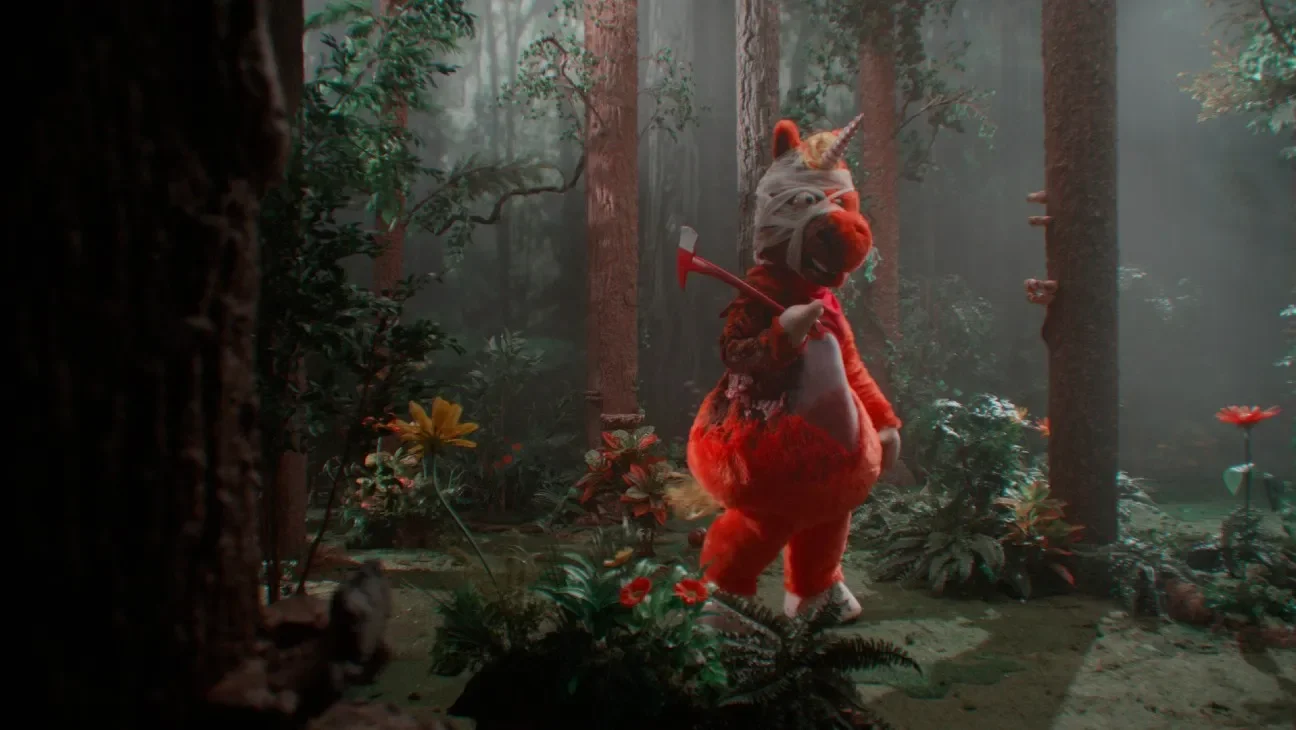
The film is set almost entirely within the puppet-filled world of a children’s television series, hosted by a bright orange unicorn named Buddy (voiced by Keegan-Michael Key with Sergey Zhuravsky in the suit) and starring a group of kids led by Freddy (Delaney Quinn of If I Had Legs I’d Kick You fame). When the kids start to realize how increasingly disturbed Buddy is – from insisting on cheeriness to straight up murdering characters – they try to find a way to escape. Meanwhile in the real world, suburban mother Grace (Cristin Milioti) starts to experience strange phenomena related to Buddy.
In its first and last third, the film has a near uncanny look and feel of the children’s shows it’s parodying. Themain setting — a clubhouse and its backyard, of course — is filled with bright oversaturated colors and very simplistic designs in a square aspect ratio. There’s a cast of sentient objects from a blue Mr. Mailbox to Freddy’s Patton Oswalt-voiced backpack Strappy. The way Buddy comes to life and talks to the children is very childish. There’s even an “I Love You”-like song to end the show. But not only does the film have the look and feel of those old shows, it’s able to deconstruct them and display something more disturbing underneath the iceberg. This was something Kelly did spectacularly with Too Many Cooks, which while on the surface is a comedic repetition of a family-friendly TV intro is a hellish depiction of being stuck in an everlasting purgatory. Underneath Buddy’s iceberg is a slasher that uses the cheery children’s show to explore themes of childhood trauma and being brave in the face of fear. Literally one of the film’s motifs is a song that goes “You gotta be scared to be brave!” (which is first sung by Buddy in response to a problem Freddy has and reclaimed later by the kids).
Another core positive of the film and why the parody works as well as it does is the children and how they’re written. Unlike the constantly happy cast in Barney & Friends, the kids in Buddy have much more of a conscience that grows throughout the story. Freddy is the perfect example of this as she has the most growth (and Quinn gives an astounding performance, no less), but even the new kids who just appear after one “disappears” in the previous episode have a good arc. How these kids end up in Buddy’s show is the big mystery, which is all explained in a very tense third act. The world-building – in the clubhouse and outside it – is also great. Kelly’s absurd flair brings the opportunity for unique jokes and twists about kids’ shows, puppetry and miniatures, and everything in relation to them. One of the sillier scenes involve a former kid (played by Clint Howard) and his ventriloquist dummy friend (voiced by, of all people, Michael Shannon) and it’s a great sliver of comedic juxtaposition to the overall unsettling narrative.
The use of puppetry and practical effects is also a big plus. Buddy looks exactly like the kind of Barney-like mascot host on a kids’ show that always seems like something about him is off, and the film is able to make fun of how Buddy is designed. Not to spoil too much, but Buddy definitely has another form and it looks super messed up in the mascot horror sort of way. Props to Key, whose cheery childish voice is so on point yet so off-putting for this type of character, and even bigger to Zhuravsky for the physical performance.
Buddy overall is an absurd, strange, and unhinged film that successfully satirizes old kids’ shows and reinvigorates mascot horror. It releases in theaters later this month, and I would advise not getting too close to the screen. You might get sucked into Buddy’s world.
