Tony
★★★★½
Suburban New Jersey, late 2000s. I was about seven years old and often woke up in the middle of the night with little chance of getting back to sleep, so I'd venture to the basement where my father let me watch recordings of his then-favorite show with him: Anthony Bourdain: No Reservations (and later Parts Unknown). For these occasional late nights until I was twelve, my dad and I watched Bourdain venture the world — experiencing the culture and foods each city/country had to offer — until I was lulled back to sleep. Recently, I revisited Bourdain through No Reservations and Parts Unknown and I found myself connecting with the charming travel documentarian on a much deeper level. And part of the reason why I was binge-watching these shows after a whole decade of not seeing either of them was frankly that — re-experiencing Bourdain through a new lens — but another was the upcoming release of this stunning biopic.
Tony is a biopic on Bourdain directed by Canadian filmmaker Matt Johnson, who launched into the stratosphere earlier this year with Nirvanna the Band the Show the Movie and has directed modern classics such as The Dirties and BlackBerry. This film stars The Holdovers’ breakthrough actor Dominic Sessa as the titular figure and co-stars Antonio Banderas, Leo Woodall, Emilia Jones, Stavros Halkias and Michael Jibrin.
It’s the summer of 1975 in Provincetown, Massachusetts. A 19-year-old Tony, fresh off a rejection for a writer’s fellowship, arrives in an effort to impress his schoolmate Nancy (Jones), essentially lying that he got in and is just “researching.” But without money and a place to stay, Tony ends up working in a seafood restaurant headed by Chef (Banderas), Sal (Woodall), and co (Halkias and Jibrin). Over the course of this summer, Tony comes of age and leaves with a newfound intent to become the celebrated chef he was known for.
There are two things this film does spectacularly that also sets itself apart from other standard biopics. The first is simple: its story. Instead of opting for a broad timeline of Bourdain’s life and death cramped in two hours, Tony focuses on a very lesser-known but formative memory: that Provincetown summer. It’s not a greatest hits album, but rather an underrated track that you grow to love. And this is an approach that is very much unique. By narrowing the focus on this one memory, the film is able to show both who Bourdain was and how he changed into the iconic chef in a manner that isn’t riskless. It’s also easily digestible for anyone with little-to-no knowledge of Bourdain; even if this wasn't about him, the film still succeeds as a self-contained bittersweet coming-of-age story. This brings me to the other great thing that it does: Tony himself.
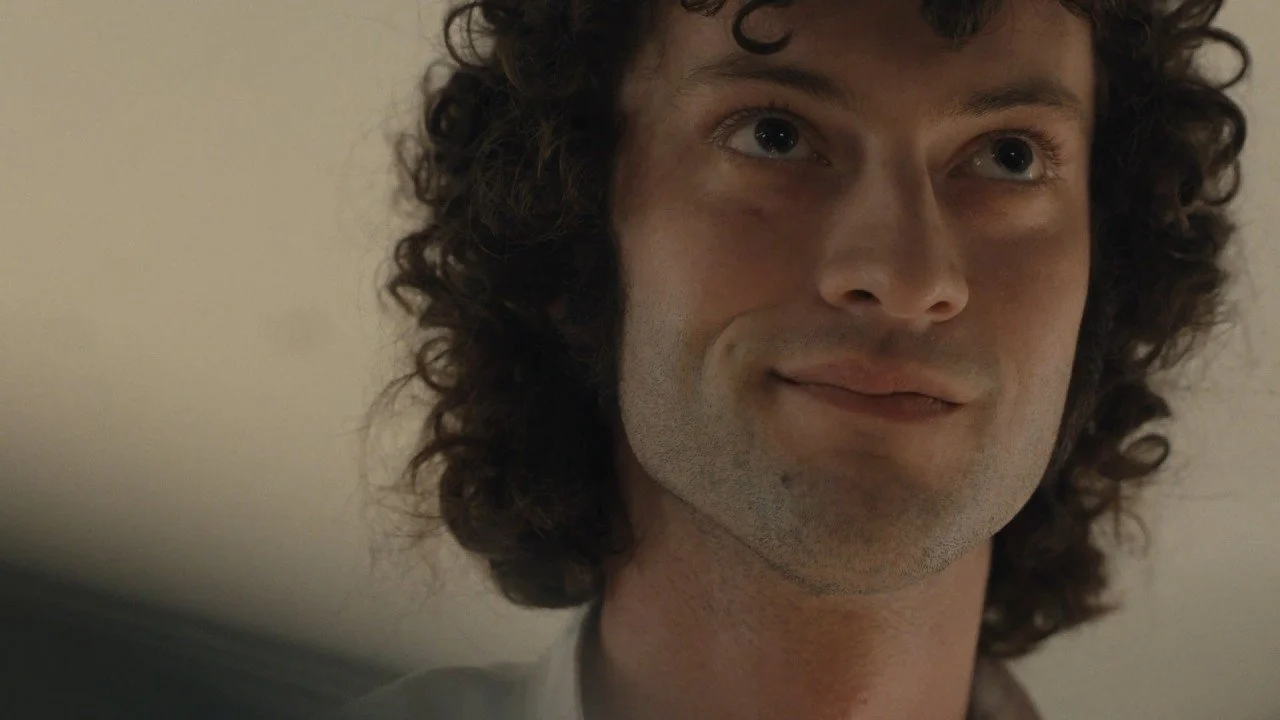
A citation we see in the film’s opening (as well as the tagline on the poster) is from Bourdain’s novel Kitchen Confidential. It’s a perfect encapsulation of Tony’s arc because he was at that age “a spoiled, miserable, narcissistic, self-destructive and thoughtless young lout, and badly in need of a good ass-kicking.” The film, to put it bluntly, is that ass-kicking. It goes out of its way to demythologize the larger-than-life Anthony Bourdain and instead present the abrasive brat Tony. Again, this is a wonderful approach because it both fits the story’s tone and humanizes Tony by giving an accurate portrayal of him, flaws and all. So when he actually does change towards the film’s end, it becomes all the more satisfying. The film also isn’t afraid to show Tony’s low points through his struggles with mental health and alcohol/drug addictions, something Bourdain still battled with as he got older and a big part of why he took his own life in 2018. Plus, Dominic Sessa is legitimately perfect as Tony. Even if he is pretty much just playing a very similar archetype as in The Holdovers, it’s an archetype Sessa nails and why he’s a perfect fit for this. He simultaneously looks, sounds and acts like a young Anthony Bourdain to a near uncanny degree.
If BlackBerry is a cousin of The Social Network, then Tony is a cousin of The Bear. The film shines the most whenever it takes place in the kitchen, indulging in the dynamics between chefs and the stressful atmosphere most of them tend to create. And not only does it get Tony into the groove of the kitchen and form relationships with his fellow chefs, it gets you into the same groove. These relationships Tony has, from being a trainee under the wing of the wise and experienced Chef to living in the fast lane with an equally self-destructive Sal, all contribute to his growth. They’re also the scenes that utilize Johnson’s signature guerrilla style the most; other scenes are much stiller in terms of cinematography. Nevertheless, it’s very committed to a 70s style movie with its production design, hair/make-up and its abundant needle drops paired with Jay McCarrol’s luscious score. In terms of acting besides Sessa, Banderas and Jones are both great in their roles, but it’s Woodall who’s an absolute scene stealer. For an Englishman, he does a spectacular job at embodying a Bay Stater, accent and all.
In conclusion, Tony is far from a safe and vapid biopic (even if its trailers make it seem so). It’s a well-cooked feast that tastes savory and intimate from start to finish. Not to speak too much on his behalf, but I strongly believe this is something Bourdain himself would have been immensely proud of.
