The Odyssey
★★★★★
Don’t you just love centuries-old literature?
Homer’s The Odyssey is widely regarded as one of history’s greatest literary achievements. Through its epic prose and incorporation of Greek mythology, it is a soaring tale about a hero’s daunting quest to return home and encountering many perils along the way. Its influence has spread into art centuries later from James Joyce’s Ulysses to the Coen brothers’ O Brother, Where Art Thou? And if you look at it just right, you can see hints of the work in The SpongeBob SquarePants Movie. But in terms of direct cinematic adaptations, this one not only takes the cake, it consumes it.
The Odyssey is written and directed by Christopher Nolan, a beloved filmmaker by critics and the general consensus. And justifiably so; his last endeavor won him two Academy Awards for Best Director and Picture. This film contains a myriad of actors (most of whom have worked with Nolan in the past) including Matt Damon, Anne Hathaway, Tom Holland, Robert Pattinson, Lupita Nyong’o, Zendaya, Charlize Theron, Samantha Morton, John Leguizamo, Elliot Page, and many more.
Weirdly enough, this casting was a point of contention before the film’s release for fairer and worse. On one side, there are criticisms regarding historical inaccuracies like steel armor, anachronistic language, and the lack of prominent Greek actors. Given that this is Nolan’s own version of a heavily mythological text, I’m more inclined to overlook these inaccuracies (although Greek representation would be nice). On the other side, there are right-wing chuds crying “woke” all because Nyong’o plays Helen of Troy and Page plays the soldier Sinon. Those remarks are nothing other than blatant bigotry and seeing them cope with the film’s overwhelming critical and commercial success (and their massive backfire) is hilarious. But I digress; let’s talk about the actual movie.
After winning the Trojan War, Odysseus (Damon) sets sail to his home kingdom of Ithaca. However, he and his crew are met with various plights: the cyclops Polyphemus, the Laestrygonians, the witch Circe (Morton), the Sirens, the Underworld and the captivity of Calypso (Theron) to name a few. Meanwhile at Ithaca, Penelope (Hathaway) must contend with a string of suitors in her husband’s absence, the most nefarious being Antinous (Pattinson); at the same time, her son Telemachus (Holland) journeys to Sparta to find out what happened to his father.
This story is told like most of Nolan’s work: non-linearly. It juggles several narrative subplots — the perils of the odyssey, Odysseus with Calypso, Telemachus, Penelope and the suitors — with scenes of the Trojan War occasionally sprinkled in. The last hour of this near three-hour gargantuan is where it’s the most linear, when Odysseus finally returns home disguised as a beggar until revealing himself in the end. In spite of all these happenings, the film is able to balance them out, giving each scene enough action to keep you interested and enough drama to make you care. Plus, the fact that the film doesn’t show the Trojan War nor the whole odyssey all at once gives the themes room to breathe. Without spoiling much, there’s a segment in that last hour where Odysseus as the beggar reflects on the war to Penelope and…well, let’s just say there’s a reason why Athena (Zendaya) comes to him sporadically. This brings me to my next point.
Time and memory are two obvious themes seen in Nolan’s films, but there’s another that isn't regarded as much. That theme is regret (and by extension guilt). We see it in almost all of Nolan’s protagonists from Leonard Shelby to J. Robert Oppenheimer. Odysseus feels no different, as his regret stems from causing massive war violence in Troy and in other acts of violence throughout his journey. His actions not only cost him his men, but also the time he lost trying to get home. It is understated how well Damon is able to portray those aspects of Odysseus. I also think this version is much more interesting than the poem since it gives the character much more emotional depth compared to other iterations where he is much less sympathetic.
The theme of loss is also expressed in Ithaca and well so. Odysseus’s family and close friend/blind herder Eumaeus (Leguizamo) hold out hope for his return, and it’s interesting to see how each of them cope with the absence. The external conflict with the suitors also adds a lot to the story, giving it a strong central antagonist in Antinous who abuses their hospitality (called in the film “Zeus’s Law”). On that somewhat related note, I love how much of a sniveling weasel Antinous is and Pattinson plays that archetype to such perfection. So when Odysseus finally returns, it’s all the more cathartic to see the payoff and the comeuppance.
It’s also very impressive to see how fleshed out the supporting cast of characters are, especially when they have such strong story significance despite short screen time. One of the film’s best examples is with Circe, who turns Odysseus’s crew into pigs after they enter her house for food (which excellently utilizes squeamish body horror), only for her to change them back upon an unfooled Odysseus’s behest. This scene is meant to reflect how war affects women, specifically the trauma of pillaging and destroying their homes, and an emotional monologue Circe gives about the greed of men is well-delivered by Morton. Even Nyong’o and Page, who the aforementioned chuds pre-emptively complained about, gave strong performances. Page as Sinon in particular has a wonderful part in the Underworld, confronting Odysseus for his lie about the Trojan Horse as a gift and how Sinon died for no noble cause.
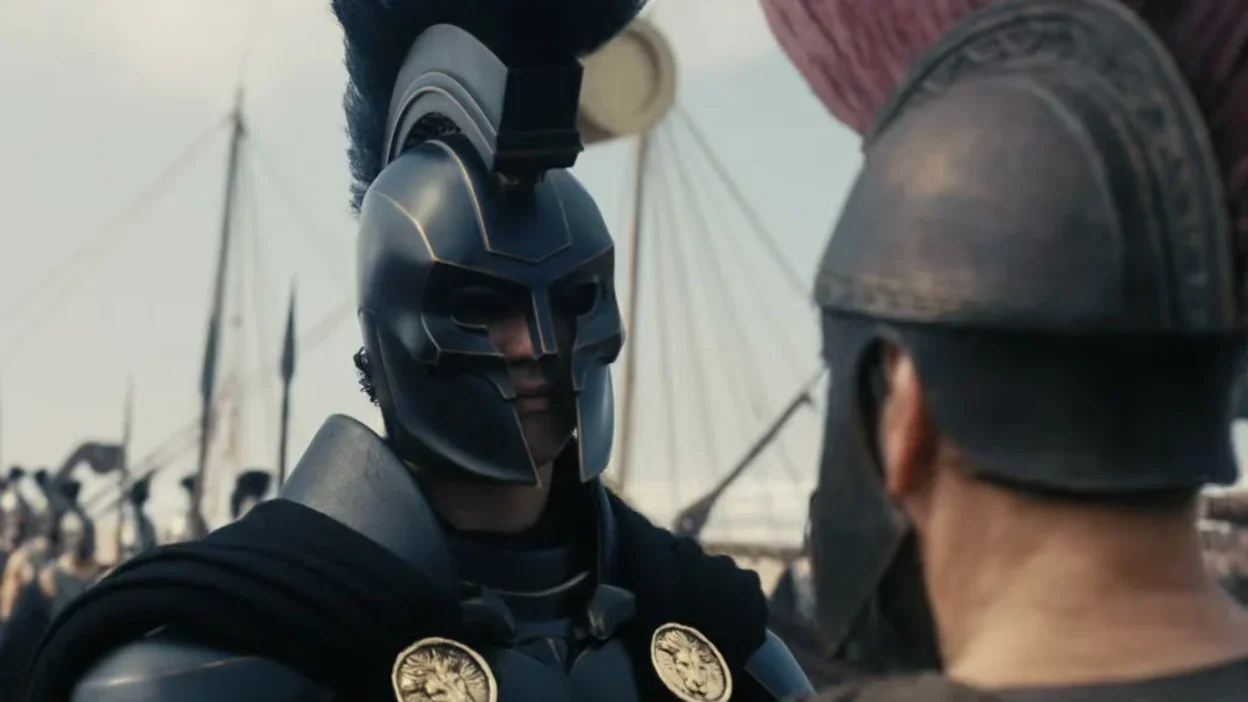
Other than narratively, The Odyssey both looks and feels epic. The film is the first one filmed entirely on IMAX cameras, so every shot is as wide and encompassing as its story. I had the rare pleasure of seeing it in IMAX 70mm in New York and can confirm it is the optimal experience for the grand scope of the film (regular IMAX would be great, too). There are also fantastic moments of horror and tension throughout, particularly with the cyclops and Circe, so much so that I firmly believe one of Nolan’s future movies should be full-on horror. The combined usages of practical and CG effects are also stunning. Now obviously, the monsters and other mythical figures had to be computer generated, but even then they don’t look horrible. Costume design is another huge plus; Agamemnon’s armor gives him such a menacing and intimidating power that it almost makes you forget he’s human. Finally, Ludwig Göransson’s score is the cherry on top to this gigantic sundae. Not only does it match the era the film takes place in (utilizing gongs, bronze instruments, and wind instruments), but it’s also used as a leitmotif, notably Odysseus plucking his bowstring preceded by the non-diegetic strikes of a lyre.
The Odyssey is without a doubt one of the best films of the year, let alone in Nolan’s filmography. And I hope like the epic before it, this film will be talked about in the centuries to come.
